- Table of Contents
- What Is Breast Fat Transfer?
- How Does Breast Fat Transfer Work?
- What Are Breast Implants?
- How Does Breast Fat Transfer Compare to Silicone Implants?
- What Is Hybrid Breast Augmentation?
- What Is Recovery Like After Each Procedure?
- What Do Results Look Like Before and After?
- How Much Does Natural Breast Augmentation Cost?
- Who Is the Best Candidate?
- Why Choose Northwest Face and Body?
- Schedule a Consultation at Northwest Face and Body
- Frequently Asked Questions
Choosing how to enhance your breasts is a personal decision, and today there are more options than ever. Two of the most popular paths are breast fat transfer and breast implants. Each method offers a different balance of size, feel, recovery, and long-term maintenance. Understanding how these procedures compare helps patients make a confident choice that fits their body and their goals. Many patients researching Fat Transfer to Breasts Bellevue start here before deciding which path to take, so this guide breaks down the pros and cons of both approaches, explains the hybrid option that combines them, and outlines who makes the best candidate for each.
At Northwest Face and Body, breast enhancement is performed by Dr. Rajshekhar Nalluri and Dr. Tarak Patel working alongside our team to help patients reach natural-looking, proportionate results.
Quick Answer: Breast fat transfer uses your own fat for a modest, natural increase in size, while breast implants deliver a larger, more predictable result. The right choice depends on the size increase you want, your available donor fat, your risk tolerance, and your recovery preferences.
Table of Contents
- What Is Breast Fat Transfer?
- How Does Breast Fat Transfer Work?
- What Are Breast Implants?
- How Does Breast Fat Transfer Compare to Silicone Implants?
- What Is Hybrid Breast Augmentation?
- What Is Recovery Like After Each Procedure?
- What Do Results Look Like Before and After?
- How Much Does Natural Breast Augmentation Cost?
- Who Is the Best Candidate?
- Why Choose Northwest Face and Body?
- Frequently Asked Questions
What Is Breast Fat Transfer?
Breast fat transfer, also called autologous fat transfer breast augmentation or fat grafting, is a procedure that enhances the size and shape of the breasts using the patient’s own fat. Instead of placing a manufactured device in the body, the surgeon relocates fat from areas where it is unwanted to the breasts. The result is a soft, natural increase in volume without introducing anything foreign.
This approach appeals to women who want a modest lift in size along with a natural look and feel. It is important to know that fat grafting adds volume, not structure. Patients seeking a large jump in cup size or significant upper-pole fullness may find that implants suit their goals better.
Key insight: Fat transfer adds natural volume, but it cannot create structure or dramatic size increases the way implants can.
How Does Breast Fat Transfer Work?
The procedure follows three main stages, and each step contributes to both breast enhancement and body contouring.
- Fat harvesting: Liposuction removes fat from donor areas such as the abdomen, flanks, thighs, or hips. This slims those areas while collecting the material needed for the transfer.
- Processing and purification: The harvested fat is cleaned through centrifugation or filtration. This removes blood, oil, and fluid, leaving healthy fat cells ready for grafting.
- Injection into the breasts: The purified fat is injected in small, even amounts across the breast tissue. Careful placement produces a smooth, natural contour and balanced shape.
Because the procedure uses liposuction, patients gain a second benefit: improved definition in the areas where fat is removed.
What Are Breast Implants?
Breast implants remain the most common method of breast augmentation. They use saline or silicone devices to add size and structure to the breast. Implants give surgeons precise control over the final size and shape, which makes them a dependable choice for patients who want a noticeable and predictable increase.
Advantages of Implants
- Predictable size increase: Implants offers a reliable and significant boost in volume.
- Variety of options: Different sizes, shapes, and fill types allow a customized result.
- Long-lasting results: Implants can last many years when no complications arise.
Considerations With Implants
- Risk of complications: There might be risk of complications including capsular contracture, rupture, or the need for revision surgery.
- More noticeable scarring: There might be more noticeable scarfs since larger incisions are required. However these are not considered a major issue with Dr. Nalluri, as he performs breast surgeries with minimally scarring techniques. Patients are advised to get a consultation before getting a surgery.
- Ongoing monitoring: Monitoring is needed as silicone implants may need periodic imaging to check for silent rupture.
- Possible effect on breastfeeding and mammograms: Techniques can be adjusted, but implants may still influence results.
How Does Breast Fat Transfer Compare to Silicone Implants?
Comparing breast fat transfer vs silicone implants side by side helps clarify which option matches your priorities. The table below shows the major differences.
| Factor | Breast Fat Transfer | Breast Implants |
| Size increase | Modest, usually one cup size | Significant and predictable |
| Feel | Soft, natural | Natural to firm depending on type |
| Foreign material | None | Saline or silicone device |
| Incisions | Small liposuction sites | Larger surgical incisions |
| Body contouring | Yes, from liposuction | No |
| Long-term monitoring | Minimal | Recommended, especially silicone |
| Revision likelihood | Possible if fat is reabsorbed | Possible over time |
| Recovery | Generally shorter | Generally longer |
The choice is rarely about which procedure is better overall. It is about which one matches your goals, your anatomy, and your comfort with maintenance.
Advantages of Fat Transfer
- Natural results: The breasts look and feel like natural tissue.
- Minimally invasive: Smaller incisions mean less scarring.
- Dual benefit: Donor areas are contoured through liposuction.
- Low reaction risk: Using your own tissue avoids the concerns tied to foreign devices.
Considerations With Fat Transfer
- Limited size increase: Large enhancements are not achievable. Patients often ask how much size can you gain with fat transfer to breasts, and in most cases, fat grafting produces about a half to one full cup size increase.
- Variable results: Some transferred fat may not survive, so outcomes can differ.
- Breast fat transfer fat necrosis risk: A small portion of fat cells can die, sometimes creating firm spots that may need attention.
What Is Hybrid Breast Augmentation?
Some patients choose a hybrid breast augmentation fat grafting approach. This method places an implant for structure and volume, then uses fat grafting to refine the shape, soften the edges, and correct any asymmetry.
How It Works?
- Implant placement: The surgeon inserts the implant to provide the main volume and structure.
- Fat transfer: Harvested fat is injected around the implant to smooth transitions, enhance cleavage, and add contour where the implant alone falls short.
Advantages of the Hybrid Approach
- Enhanced aesthetics: A more tailored, natural slope and contour.
- Improved feel: The fat layer softens the edges of the implant.
- Dual benefit: Donor areas are contoured through liposuction.
- Correction ability: Helpful for asymmetry or refining results from previous surgery.
Considerations
- Higher complexity and cost: Combining procedures increases surgical time and expense.
- Fat reabsorption risk: As with fat transfer alone, some fat may not survive.
- Candidate suitability: This option requires enough donor fat and healthy breast tissue.
This method, also referred to as composite breast augmentation, gives patients the size of an implant with the natural refinement of fat grafting, but it is best suited to those with adequate donor fat.
What Is Recovery Like After Each Procedure?
Recovery differs between the two procedures. Breast fat transfer recovery time is generally shorter and more comfortable than implant surgery. Most patients return to normal activities within about a week, though full results appear once swelling settles and the transferred fat stabilizes over a few months.
Implant recovery usually takes longer because of the larger incisions and the placement of the device. Patients should follow their surgeon’s aftercare plan closely to support healing and protect the result.
What Do Results Look Like Before and After?
Reviewing breast implants vs fat transfer before and after photos during a consultation gives patients the clearest sense of realistic outcomes for their own body type. In general, fat transfer before-and-after photos show a subtle, gradual change: the breasts appear fuller and rounder without a dramatic jump in size, and the donor areas, such as the abdomen or thighs, often look more contoured too.
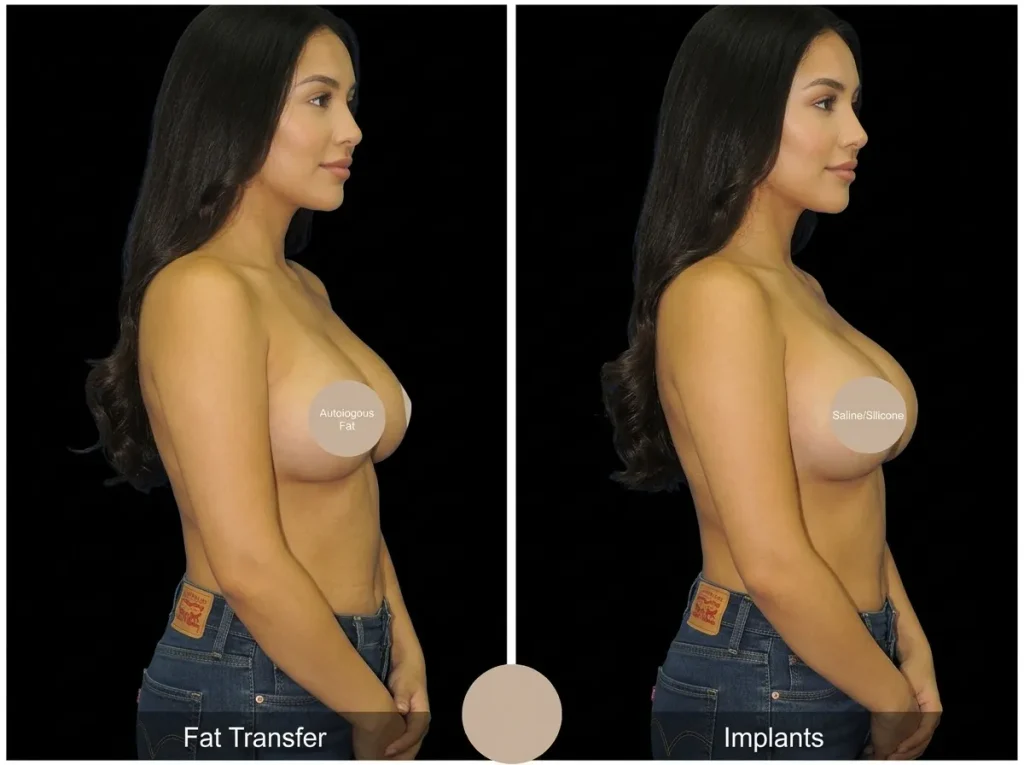
Implant before-and-after photos usually show a more immediate and noticeable size increase, with firmer upper-pole fullness that fat transfer alone cannot replicate. Hybrid procedure photos tend to fall between the two, showing the size increase of an implant with softer, more gradual edges from the added fat grafting. As results vary by body type and technique, a consultation with photos of prior patients with a similar starting shape is more useful than generic before-and-after galleries found online.
How Much Does Natural Breast Augmentation Cost?
For patients exploring natural breast augmentation cost, fat transfer pricing depends on the number of donor areas treated and the amount of fat needed. At Northwest Face & Body, the cost of Fat Transfer to Breast starts at $6,995 with 1 area of liposuction. It is recommended to take a consultation to get a final quote before getting the surgery.
Who Is the Best Candidate?
Identifying the best candidate for natural breast enhancement comes down to goals and anatomy.
Fat Transfer Suits Patients Who:
- Want a modest, natural increase in size
- Prefer an alternative to implants
- Have enough fat reserves in donor areas for harvesting
- Want the added benefit of body contouring
Implants Suit Patients Who:
- Want a significant and predictable size increase
- Prefer defined upper-pole fullness
- Do not have enough donor fat for grafting
- Accept the maintenance that comes with implants
Patients searching for Fat Transfer to Breasts in Kirkland can schedule an evaluation to learn which method fits their body type, tissue quality, and desired outcome. A personal assessment remains the only reliable way to confirm candidacy either way.
Why Choose Northwest Face and Body?
Breast enhancement at Northwest Face and Body is led two of the best surgeons, Dr. Rajasekhar Nalluri & Dr. Tarak Patel.
Dr. Rajasekhar Nalluri, a board-certified plastic surgeon with more than 23 years of experience and over 20,000 surgical procedures performed. He has been board-certified by the American Board of Plastic Surgery since 2003 and specializes in breast procedures, including augmentation, breast lift, and reconstruction.
Dr. Tarak Patel is double board-certified in Plastic Surgery and General Surgery. A graduate of West Point, he was commissioned into the United States Army, attended medical school at the Uniformed Services University of Health Sciences, and completed his plastic surgery residency at the University of Texas Health Science Center at San Antonio. He served as an Army surgeon for 25 years, including deployments in support of Operation Iraqi Freedom, before retiring from the military in 2018.
Patients receive individualized treatment planning based on their anatomy, aesthetic goals, available donor fat, and desired level of enhancement. Moreover, patients also have the option to choose from Dr. Nalluri & Dr. Patel, who would further discuss whether breast fat transfer, implants, or another approach may be appropriate during a personalized consultation.
Schedule a Consultation at Northwest Face and Body
Choosing between breast fat transfer, implants, or a hybrid approach is easier with expert guidance. Dr. Rajshekhar Nalluri or Dr. Tarak Patel at Northwest Face and Body evaluates each patient individually and explains which procedure aligns with your body type, aesthetic goals, and lifestyle. Whether you want a natural enhancement or a larger, more defined result, our team helps you make a confident, informed decision. Patients looking for Fat Transfer to Breasts near me can contact Northwest Face and Body today to schedule a consultation and take the first step toward the results you have been considering.
Frequently Asked Questions
Can fat transfer completely replace breast implants?
For patients wanting a modest, natural increase, yes. Those wanting a large jump in size usually need implants or a hybrid approach.
Is breast fat transfer permanent, or does the fat disappear over time?
The surviving fat cells stay for the long term, though some fat is reabsorbed in the first few months. The result that remains after stabilization is lasting.
Does breast fat transfer affect mammograms or breast cancer screening?
Fat grafting can create small calcifications, but experienced radiologists can distinguish these from concerning findings. Always tell your imaging team about any breast procedure.
Does insurance cover breast fat transfer or breast implants?
Both procedures are typically considered cosmetic and are not covered by insurance, unless performed as part of reconstructive surgery following a mastectomy or injury.
How long do breast implants last compared to fat transfer results?
Implants generally last many years but may eventually need replacement due to wear or complications. Fat transfer results, once the surviving fat has stabilized, tend to remain stable long-term without a scheduled replacement.